
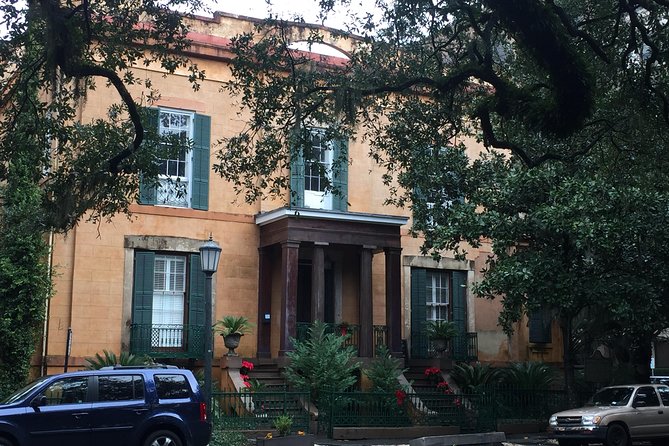
Reviewed · SAVANNAH SQUARES & HISTORIC WALKING TOURS
Heart of Savannah History Walking Tour – 2hr
Savannah has a way of sticking with you. This 2-hour walking tour threads together big moments and small details as you move square to square and finish at Forsyth Park. I love how the guide explains the city’s square design and ties it to how Savannah was planned and defended. One watch-out: most stops are outside viewing, so if you want long indoor museum time, you’ll still need a bit of self-guided add-on.
The best part for me is the storytelling mix. You’ll get Revolutionary War and Civil War references in the same stroll as pop-culture flashpoints like the Forrest Gump scene at Chippewa Square. I also like that the route ends at a payoff you can’t miss: the Forsyth Park Fountain for an easy photo finish.
In This Review
- Key highlights to know before you go
- Entering the Historic District on Foot: the smart way to start in Savannah
- Wright Square: where Savannah’s plan starts to make sense
- Juliette Gordon Low Birthplace: founder legacy, viewed from the street
- Independent Presbyterian Church: fires, hurricanes, and a steeple with stories
- Chippewa Square: the Forrest Gump moment and the real Oglethorpe connection
- Sorrel Weed House: why the gray brick wall is part of the legend
- Madison Square: a Revolutionary War turning point in a small space
- Green-Meldrim House: Gothic architecture and Sherman’s headquarters
- The SCAD Volunteer Guard building: passing the institutional history
- Gryphon Tea Room inside the Shriners Building: old apothecary details you can spot
- Midnight in the Garden of Good and Evil: the Mercer Williams House story
- Armstrong-Kessler House: admire it, even if it stays private
- Forsyth Park: the fountain payoff and how Savannah parks are built
- Value and pace: what you get in two hours (and what you do not)
- Who this tour fits best
- Final call: should you book Heart of Savannah History Walking Tour?
- FAQ
- How long is the Heart of Savannah History Walking Tour?
- Where does the tour start and where does it end?
- Is the tour offered in English, and is there a choice of time?
- Do you go inside the Juliette Gordon Low Birthplace Museum?
- Is the tour available in bad weather?
- How much walking is involved?
- Can I cancel for a full refund?
Key highlights to know before you go

- Wright Square orientation with Oglethorpe’s 40-foot bluff story and Tomochichi’s connection
- Forrest Gump at Chippewa Square, plus the real meaning behind the Oglethorpe monument
- Ghost-lore stops like the Sorrel Weed House, explained through buildings and local details
- Civil War era markers, including Sherman’s headquarters at Green-Meldrim House
- Film and literature history around Midnight in the Garden of Good and Evil at the Mercer Williams House
- Forsyth Park Fountain at the end, with a famous catalog-mail-order backstory from France
Entering the Historic District on Foot: the smart way to start in Savannah
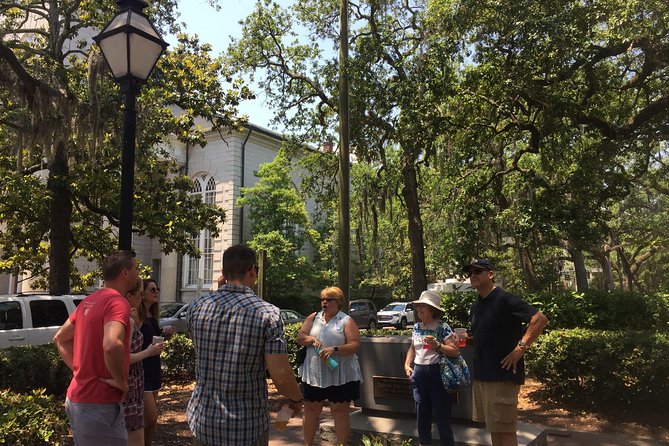
If Savannah is new to you, this is a strong first-day choice. The tour is about 2 hours and covers roughly a mile with benches along the way, which keeps it doable even when the sidewalks feel busy. It is also designed for orientation: you’re not just looking at pretty buildings, you’re learning why Savannah’s layout works and how the city’s story unfolded block by block.
The group stays small, with a maximum of 30 travelers, and the format is quick-stop sightseeing. That matters because Savannah moves fast. If you want to do more later, you need a base map in your head by the time you’re done here.
You’ll carry a mobile ticket, and the tour runs in English. It operates rain or shine, so bring practical stuff: comfortable walking shoes, and if it’s summer, water and shade breaks help a lot. An umbrella is also a good idea because this is an outdoor walk through open squares.
We have more walks through Savannah's historic squares and old district to wander



Wright Square: where Savannah’s plan starts to make sense
The tour begins in the middle of the north side of Wright Square, in front of the Gordon Monument. This first stop does two useful things at once: it gives you the founding background and it shows how Savannah’s designers thought.
You’ll hear why Savannah began on a 40-foot bluff, and how that setting mattered for the colony’s early life and defense. You’ll also learn why the squares exist where they do and how they shape the way you move through town. That “oh, that’s why they did it” moment is the whole point of starting here.
Two other details make Wright Square memorable. One is the connection to the Yamacraw Indians through Tomochichi, the chief, and the fact that he is buried under the Gordon Monument. The other is a modern reminder that Savannah isn’t just history—it’s a real port city too, with the Port of Savannah noted as the third-largest port in the nation.
Juliette Gordon Low Birthplace: founder legacy, viewed from the street
Next you’ll admire the Juliette Gordon Low Birthplace, the home where she was born on October 31, 1860 and later became the founder of the Girl Scouts. Important detail: the tour does not go into the home. You’ll view it from the outside, which keeps the pace tight and keeps you moving square to square.
If you love social history, this stop adds a different flavor to the walk. You’re not only dealing with wars and presidents. You’re also seeing how Savannah produced a person who shaped youth activities far beyond Georgia.
Independent Presbyterian Church: fires, hurricanes, and a steeple with stories
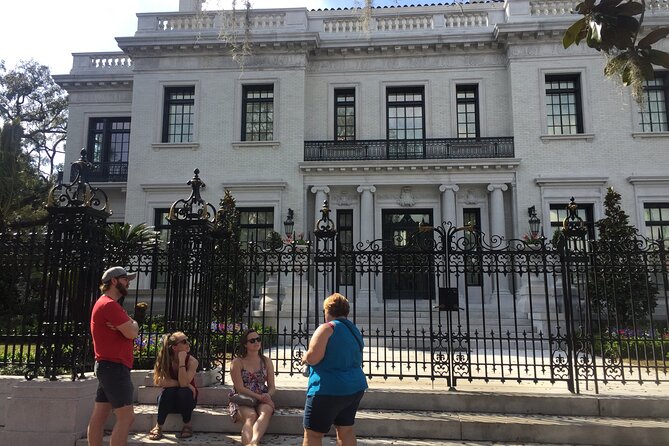
The Independent Presbyterian Church is one of those places where you learn how survival and rebuilding were part of the city’s rhythm. You’ll get a timeline: the church was founded in 1755 on Ellis Square (originally Market Square), then it was destroyed by fire. Rebuilding happened on Telfair Square, and that effort was later destroyed by a hurricane.
Today, it sits on the corner of Bull St and Oglethorpe Ave. The tour notes it was built in 1855, and the guide will explain which U.S. President was married there in 1885, along with why the steeple is famous today.
Even if you don’t catch every detail, the takeaway is clear: Savannah buildings carry layers. The exterior may look singular, but the story behind it often isn’t.
Chippewa Square: the Forrest Gump moment and the real Oglethorpe connection
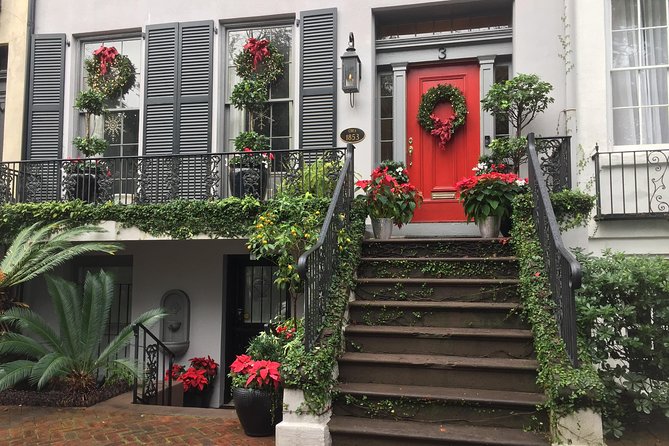
If you only remember one pop-culture stop, make it this one. At Chippewa Square, you’ll see where Forrest Gump sat with his box of chocolates while waiting for the bus.
Then you’ll get the local-corrective part that makes this more than a photo stop. The monument in the center of the square is General James Oglethorpe, not Captain Morgan. The tour even points out how easily people mix them up, and Savannah’s casual-to-go coffee culture makes that comparison feel extra on-point.
This stop works because it links film trivia to actual city history. Oglethorpe is the man behind the colony’s start, and the square gives you a visual reminder of how power and planning showed up in public space.
There is more Savannah history to walk through with our other tours





Sorrel Weed House: why the gray brick wall is part of the legend
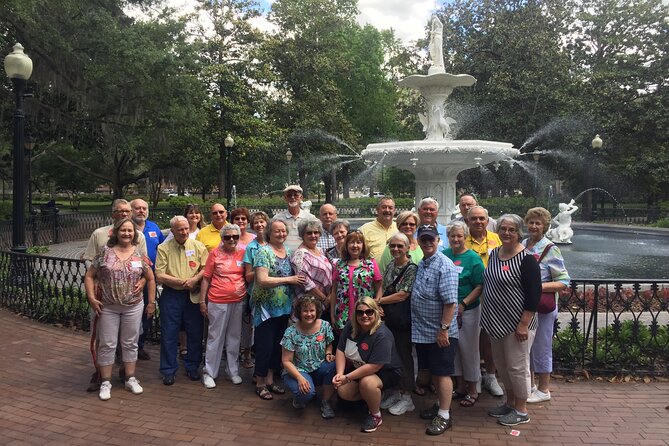
You’ll pass by the Old Sorrel Weed House Museum & Tours, often labeled as one of Savannah’s most haunted homes. This is not a long inside stop, but you still get the kind of detail that makes Savannah legends feel grounded.
The guide will point out the gray brick wall surrounding the courtyard and share why there are fingerprints in the brick—and where that brick came from. That kind of explanation matters. It turns the spooky headlines into something you can actually picture on the street.
If you like ghost stories, you’ll probably enjoy the tone here. If you prefer straight history, you can still appreciate how locals use architecture, materials, and traditions to tell their stories.
Madison Square: a Revolutionary War turning point in a small space
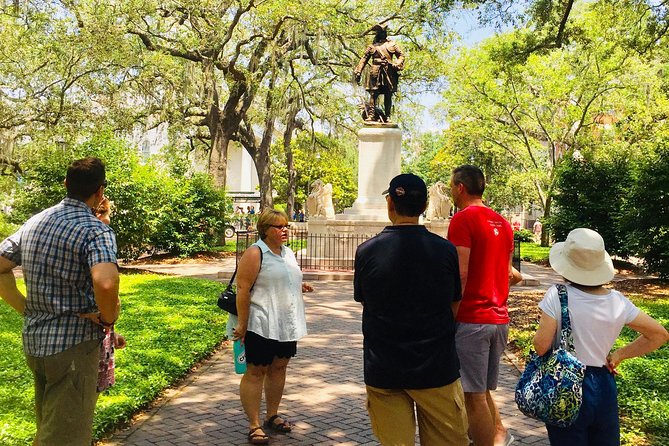
At Madison Square, the tour focuses on a heavy moment: the site of one of the bloodiest battles during the American Revolution, tied to the Siege of Savannah.
This stop is short, but it gives you an emotional anchor. One of the easiest ways to understand a city is to learn what happened in the same square you’re now enjoying for photos and people-watching. Madison Square helps you connect Savannah’s present-day calm to the conflict that shaped its future.
Green-Meldrim House: Gothic architecture and Sherman’s headquarters
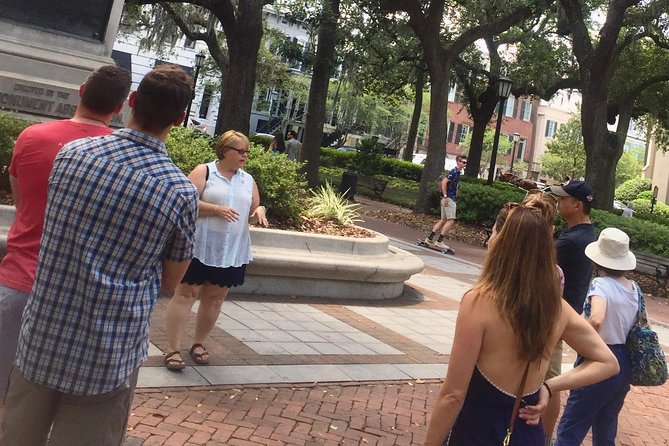
The walk continues to Green-Meldrim House, completed in 1853 and described as the finest example of Gothic Architecture in the South. The tour shares a very specific price point: it cost $93,000 at the time, which is given as about $3.2 million today.
That’s not just trivia. It helps you understand what wealth looked like in 1800s Savannah and why houses like this became statements.
Another key detail: this home served as Headquarters for General Sherman during his March to the Sea, when he occupied Savannah. So while you’re looking at a house style associated with grandeur, you’re also looking at a place tied to one of the most consequential campaigns of the Civil War.
The SCAD Volunteer Guard building: passing the institutional history
You’ll also pass the building originally built and used as the Savannah Volunteer Guard building, which today is owned by SCAD. This is a quick visual stop, but it’s a reminder that Savannah’s old structures don’t disappear—they often change hands and change functions while staying part of the city’s streetscape.
Gryphon Tea Room inside the Shriners Building: old apothecary details you can spot
One of the tour’s more relaxed moments comes near the Shriners Building, where the Gryphon Tea Room sits. The tour highlights that inside this space is a museum in its own right, connected to its earlier use as Solomon’s Apothecary.
You’ll be told about the original mahogany cabinetry and cubbies used to store medicines. Even if you don’t plan to stop for a meal right then, it’s the kind of detail that helps you understand how commercial spaces in Savannah often hold practical history.
The guide also calls out the tea room as a favorite for lunch, dinner, or just to relax with a cup of tea. If your feet need a breather, this is an easy place to do it.
Midnight in the Garden of Good and Evil: the Mercer Williams House story
Next is the Mercer Williams House, famous thanks to Midnight in the Garden of Good and Evil by John Berendt. The tour connects the book directly to the real person: Jim Williams purchased the home in 1969, and the tour notes the shooting of his assistant Danny in 1981.
Then it brings in the publishing and film impact. The book was released in 1993, spent 216 weeks on the New York best seller list, and the movie helped put Savannah more fully on the tourism map.
This stop is for you if you enjoy character-driven stories. It’s also for you if you like seeing how literature shapes what people think they’re seeing in a place.
Practical tip: if you’ve read the book or watched the movie, you may find the explanations stick better. If you haven’t, it still works as a street-level introduction.
Armstrong-Kessler House: admire it, even if it stays private
Toward the end of the walk, you’ll reach Armstrong House, now known as the Armstrong-Kessler house. The tour discusses the home’s history and what’s known about who lives there today.
Here’s the practical point: it is a private home today and not open for tours. The tour also notes this is the one home where people often stop, look up, and say wow. That makes sense—sometimes the value of a stop is the exterior impact, not the interior.
Also note: the itinerary specifies admission for this home is not included, which is another reason the tour keeps it as a viewing moment rather than a ticketed attraction.
Forsyth Park: the fountain payoff and how Savannah parks are built
The tour ends at Forsyth Park, specifically at the Fountain. If you want a clean finish to your first Savannah day, this is it.
The park began in 1848 at 10 acres, and it covers 30 acres today. The tour calls it Savannah’s central park enjoyed by people of all ages, and once you arrive, you’ll understand why. It gives you open space right after the tight square network of the historic district.
The main photo magnet is the Forsyth Park Fountain. The tour includes a fun detail that explains why it looks so distinctive: it was a catalog mail order from France, installed in 1858. This is the kind of fact that turns a familiar landmark into a fresh story.
If you’re planning the rest of your day, this end point is convenient. You can keep walking, grab a snack nearby, or sit and decompress after the history-and-stories pace.
Value and pace: what you get in two hours (and what you do not)
Most stops on this walk are set up as quick, guided markers, and that’s a feature. You get a guided city orientation, plus a lot of named places and clear context for how Savannah developed.
Also, the tour notes admission ticket is free for multiple stops. That means your money is largely going toward the professional local guide and the narration, not toward a stack of entry fees.
What to watch for is the indoor time. Several key spots are outside viewing:
- the Juliette Gordon Low birthplace is admired from the outside
- some houses are passed by, not toured inside
- the Armstrong-Kessler house is not open for tours
So if you want a museum-heavy itinerary, treat this as the scaffold for later self-guided exploration.
As for comfort, the route is planned for walking with benches and a short total distance. Still, Savannah weather can change fast. Bring water in summer and use an umbrella if there’s rain in the forecast.
Who this tour fits best
I think this tour is ideal if:
- you want a first-timer orientation to Savannah’s historic district
- you like history that is tied to places you can actually see
- you enjoy pop-culture references like Forrest Gump and the Midnight story
- you want a guide who keeps things moving and makes the details easier to remember
It may be less ideal if:
- you strongly prefer lots of indoor museum time
- you are looking for a slow, question-heavy pace at every stop
Final call: should you book Heart of Savannah History Walking Tour?
Book it if you want the fastest way to understand Savannah’s why. The mix of squares, architecture, and major American storylines gives you a base map for the rest of your trip. The Forsyth Park Fountain ending is a great way to close the loop with a landmark that is both beautiful and easy to revisit on your own.
Skip it (or pair it with extra stops) if indoor ticketed experiences are your top priority. This tour’s strength is the street-level stories, not long time inside.
If your goal is to leave Savannah feeling like you actually understand the city, this walk is a smart start.
FAQ
How long is the Heart of Savannah History Walking Tour?
It runs for about 2 hours.
Where does the tour start and where does it end?
It starts at Wright Square in Savannah and ends at the Forsyth Park Fountain.
Is the tour offered in English, and is there a choice of time?
Yes, it is offered in English, and you can choose from a morning or afternoon tour time.
Do you go inside the Juliette Gordon Low Birthplace Museum?
No. You admire it from the outside.
Is the tour available in bad weather?
It operates rain or shine. In severe weather, you’ll be offered an option to reschedule (no refunds unless the tour is canceled).
How much walking is involved?
The route is about 1 mile, with benches along the way.
Can I cancel for a full refund?
Yes. You can cancel for a full refund as long as you cancel at least 24 hours before the experience starts.
More Tours in Savannah



More Tour Reviews in Savannah

More Savannah Squares and Historic Walking Tours
Not quite your thing? Here is more to see and do around Savannah












Savannah Squares & Historic Walking Tours, compared.
 ★ 5.0Savannah History and Haunts Candlelit Ghost Walking TourFrom $393,235 reviews
 ★ 5.0Savannah First Squares Culinary & Cultural Walking Food TourFrom $963,229 reviews
 ★ 5.0Historic Savannah Guided Walking TourFrom $302,918 reviews
 ★ 4.5Savannah’s Ghost City “Dead of Night” Walking Night TourFrom $342,482 reviews
 ★ 4.5Narrated Historic Savannah Sightseeing Trolley TourFrom $352,375 reviews
 ★ 4.5Southern Flavors Food, Pub Crawl, and History Walking TourFrom $601,623 reviews
 ★ 5.0Genteel and Bard’s Savannah Dark History and Ghost Encounter Walking TourFrom $391,546 reviews
 ★ 5.0Bonaventure Cemetery Walking Tour with TransportationFrom $481,467 reviews
Browse the lists this tour appears in