
Reviewed · SAVANNAH SQUARES & HISTORIC WALKING TOURS
90 Minutes Walking Tour in Savannah
Savannah history, paced at an easy walk. In 90 minutes, you’ll get a clear route through the city’s famous squares, big churches, and cemetery stories, all with a live guide.
What makes it especially appealing is that most stops don’t require paid admission, so your money goes into the thinking and storytelling—not ticket math.
I like how the tour builds a sense of Savannah’s layout fast, starting in Johnson Square and ending at the Forsyth Fountain. I also like the small-group feel (max 15), which gives you room to ask questions and get real answers, whether you end up with guides such as Deborah or Andrew (including Andrew Cotton, based on past guides). One consideration: it’s a walking tour with no food or drink, so bring water and plan to refuel after.
In This Review
- Key things to know before you go
- Why Savannah makes sense when you walk its squares
- Price and what makes the $30 feel fair
- The route: Johnson Square to Forsyth Park in one story
- Stop 1: Johnson Square and Christ Church’s origin story
- Stop 2: Wright Square, the Court House Square, and hard civic history
- Stop 3: Colonial Park Cemetery, Civil War memory, and Victorian relocation
- Stop 4: Chippewa Square, the Forrest Gump bus moment, and Oglethorpe at center
- Stop 5: Cathedral of St. John the Baptist and Savannah’s Catholic anchor
- Stop 6: Madison Square with Sgt Jasper, Siege of Savannah, and neighboring landmarks
- Stop 7: Monterey Square, Pulaski, Mickve Israel synagogue, and Midnight in the Garden of Good & Evil
- Stop 8: Forsyth Park and the Forsyth Fountain photo moment
- What the guide experience feels like in practice
- What to bring and how to pace yourself
- Who this tour is best for (and who should skip it)
- Should you book this Savannah walking tour?
- FAQ
- How much does the Savannah walking tour cost?
- How long is the tour, and where does it start and end?
- Are any of the stops included with paid admission?
- What language is the tour offered in?
- How large is the group?
- Is food or drink included?
- What happens if I need to cancel?
Key things to know before you go
- Johnson Square start, Forsyth Park finish: the route is designed for first-time orientation.
- No paid entry at the stops: each main stop is listed as admission ticket free.
- A “squares-first” storyline: you learn how Savannah’s civic spaces shaped life and conflict.
- Churches + cemetery history in one loop: you’ll see why religion and memory mattered here.
- Expect a slightly flexible pace: the tour can run a bit longer when the guide slows down for good questions.
- Small groups make it conversational: max 15 keeps the experience more personal.
Why Savannah makes sense when you walk its squares
Savannah is all about place and spacing. The city’s squares are more than pretty greens—they were built for governance, community gatherings, and public drama. Walking them in order helps you see how the city grew from a plan into a lived-in world.
This tour is built around that idea. You’re not just collecting photos. You’re building a mental map: where power sat, where people were buried, where battles echoed, and where later stories turned into movie-ready scenery. If you like history that feels connected instead of chopped into museum-sized pieces, this format fits well.
We have more walks through Savannah's historic squares and old district to wander


Price and what makes the $30 feel fair
At $30 per person for about 1.5 hours, you’re paying mainly for a guide-led narrative and a tight route. That’s a good deal in Savannah, where you can burn time hopping between sights without fully understanding what you’re seeing.
The value also comes from what’s not included. Stops are listed as admission ticket free, and the tour includes the guide but not food or drink. So you’re not paying extra just to stand in front of a landmark. You can also book ahead—on average 35 days out—which is useful if you’re planning around a specific time window in town.
The route: Johnson Square to Forsyth Park in one story
You’ll move at a steady walking pace, with around 10 minutes at each stop. That short time is the point: you get enough context to recognize what you’re looking at, then you keep moving while the city still feels fresh and ordered.
Here’s what you’ll experience stop by stop.
Stop 1: Johnson Square and Christ Church’s origin story
Johnson Square is where Savannah starts showing its logic. The tour begins with an introduction to the city and points out Christ Church, including its heritage and history. You’ll also connect Johnson Square with the idea that it was Savannah’s first square and a starting point for the city’s development.
What I like about leading with this is that it gives you a foundation. If you only start later, Savannah can feel like a string of pretty scenes. Starting here helps you understand what the squares were meant to do and why the early anchors mattered.
Stop 2: Wright Square, the Court House Square, and hard civic history
Next up is Wright Square, also known as the Court House Square. This stop reframes the square as a justice-and-control hub, tied to the first Federal Courthouse, County Courthouse, jail, and even burial grounds.
That mix is sobering, but it’s also useful. You’ll look at the landscape differently once you know it held trials, confinement, and the reality of how the city managed death. It’s a quick lesson in how public space can carry serious weight.



Stop 3: Colonial Park Cemetery, Civil War memory, and Victorian relocation
Colonial Park Cemetery is Savannah’s Colonial-era cemetery with a story that stretches far beyond dates on a headstone. The tour explains its role during the Civil War and then its later connection to being transported as part of the movement toward Victorian cemeteries.
This stop works best if you’re the type who likes context. You’ll walk away with more than a sense of age—you’ll understand how attitudes toward burial and remembrance changed over time. Even in a short visit, it plants a theme you’ll see again in later Savannah stories.
Stop 4: Chippewa Square, the Forrest Gump bus moment, and Oglethorpe at center
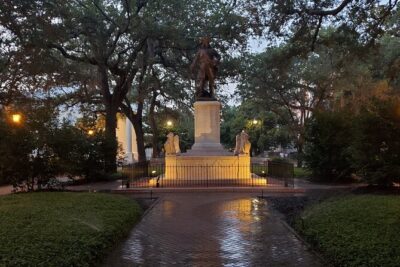
Chippewa Square is where pop culture earns its place in city history. The tour notes how the square became famous through the Forrest Gump bus-waiting scene, while also circling back to the city’s origin with the statue of General James Oglethorpe at the center.
If you’re a first-time visitor, this stop is fun and grounding at the same time. You get the instant recognition factor, then you connect it to the real founder who shaped Savannah’s early plan. That blend is exactly what a good orientation tour should do.
Stop 5: Cathedral of St. John the Baptist and Savannah’s Catholic anchor
The Cathedral of St. John the Baptist is next, and the tour focuses on why it’s such a standout. You’ll hear how it began as a church in the 1700s, while the actual basilica building was built in the middle 1800s. The tour also points out that it’s open daily.
This stop is valuable because churches in Savannah aren’t just architecture—they’re community anchors. Even with limited time, you’ll come away with a sense of continuity: faith, rebuilding, and a growing city putting resources into lasting structures.
Stop 6: Madison Square with Sgt Jasper, Siege of Savannah, and neighboring landmarks
At Madison Square, you’ll meet the story of Sgt Jasper, tied to the Siege of Savannah and described as fatally wounded there. The stop also mentions St. John’s Episcopal Church and the Green Meldrim house as part of the square’s surrounding context.
This is where the tour links place to conflict in a very concrete way. Instead of treating battles like separate textbook events, you see how the city’s public spaces absorbed war, memory, and aftermath.
Stop 7: Monterey Square, Pulaski, Mickve Israel synagogue, and Midnight in the Garden of Good & Evil
Monterey Square is packed with “look closer” details. The tour explains the square’s naming from the Battle of Monterey, and it points out General Casimir Pulaski at the center. It also highlights the Mickve Israel synagogue in Gothic Revival style and mentions the Mercer Williams house, which connects to Midnight in the Garden of Good & Evil and multiple films shot in Savannah.
This stop is a big reason people love Savannah: the city feels layered, with civic history, religious architecture, and modern storytelling all sharing the same space. The time is short, so you’ll want to pay attention to shapes and styles—Gothic Revival details in particular—and let the guide connect them to why they’re there.
Stop 8: Forsyth Park and the Forsyth Fountain photo moment
The tour ends at Forsyth Park, after entering the park leads you to the famous Forsyth Fountain. The tour frames the park as a 30-acre meeting place, with festivals, a farmers market, and lots of nearby dining options. You’ll also get a quick sense that the park’s history is well documented and easy to keep exploring after the walk.
Ending here is smart. It’s a visual release after the denser history stops, and it gives you a strong payoff: a landmark you can recognize instantly and a place to linger on your own.
What the guide experience feels like in practice
The tour’s quality is in the person running it. Past guides include Deborah and Andrew (including Andrew Cotton), and their common thread is storytelling backed by research. They don’t just list facts; they explain how and why Savannah developed the way it did.
In a smaller group, the tour tends to feel more like a conversation than a lecture. One reason that matters is that you get permission to ask questions or adjust for quick needs like a short pause. The trade-off is that this can make the walk run a little longer than the printed estimate—usually because the guide is making sure you actually get it, not because they’re rushing you along.
What to bring and how to pace yourself
This is a walking tour with no food or drink included. That means you should plan your hydration and energy for the 90-minute window. Comfortable shoes matter here more than you’d think, because Savannah’s charm is in walking slowly, not just stepping between photo stops.
It also helps to go in with the right mindset. Expect short stops with focused explanations, not long, slow visits inside buildings or cemeteries. If you want to linger, treat the tour as your guided map, then come back on your own time.
Who this tour is best for (and who should skip it)
This works especially well if you’re:
- Visiting Savannah for the first time and want a fast, organized understanding.
- Interested in how squares connect to governance, religion, battles, and public life.
- Short on time but still want meaningful context rather than a hit-and-run photo walk.
You might want a different format if you:
- Need lots of rest breaks or you dislike steady walking.
- Want a tour focused on one building or one attraction in deep detail rather than a broad city overview.
Should you book this Savannah walking tour?
I’d book it if you want Savannah’s story in the right order. It’s $30, around 1.5 hours, and the route gives you structure: Johnson Square to Forsyth Park, with a chain of squares and landmarks that explain why the city looks the way it does.
Book it especially if you like your history tied to real locations and you’d rather start with a guide-led map than wander and guess. Just go prepared for a walking experience with no food or drink, and you’ll get a lot out of the time you spend.
FAQ
How much does the Savannah walking tour cost?
The price is $30.00 per person.
How long is the tour, and where does it start and end?
The tour runs for about 1 hour 30 minutes. It starts at Johnson Square (2 E Bryan St, Savannah, GA 31401) and ends at Forsyth Park, at the Forsyth Fountain.
Are any of the stops included with paid admission?
No. The tour lists all main stops as admission ticket free.
What language is the tour offered in?
The tour is offered in English, and you’ll receive a mobile ticket.
How large is the group?
The tour has a maximum group size of 15 travelers.
Is food or drink included?
No. No food or drink is provided, so you’ll want to plan for your own snacks and water.
What happens if I need to cancel?
You can cancel for a full refund if you cancel up to 24 hours in advance of the experience start time.
If you want, tell me your travel dates and whether you prefer history, architecture, or movie-famous spots. I can suggest the best time of day to do this route.
More Tours in Savannah


More Tour Reviews in Savannah
More Savannah Squares and Historic Walking Tours


Not quite your thing? Here is more to see and do around Savannah











Savannah Squares & Historic Walking Tours, compared.
 ★ 5.0Savannah History and Haunts Candlelit Ghost Walking TourFrom $393,235 reviews
 ★ 5.0Savannah First Squares Culinary & Cultural Walking Food TourFrom $963,229 reviews
 ★ 5.0Historic Savannah Guided Walking TourFrom $302,918 reviews
 ★ 4.5Savannah’s Ghost City “Dead of Night” Walking Night TourFrom $342,482 reviews
 ★ 4.5Narrated Historic Savannah Sightseeing Trolley TourFrom $352,375 reviews
 ★ 4.5Southern Flavors Food, Pub Crawl, and History Walking TourFrom $601,623 reviews
 ★ 5.0Genteel and Bard’s Savannah Dark History and Ghost Encounter Walking TourFrom $391,546 reviews
 ★ 5.0Bonaventure Cemetery Walking Tour with TransportationFrom $481,467 reviews
Browse the lists this tour appears in